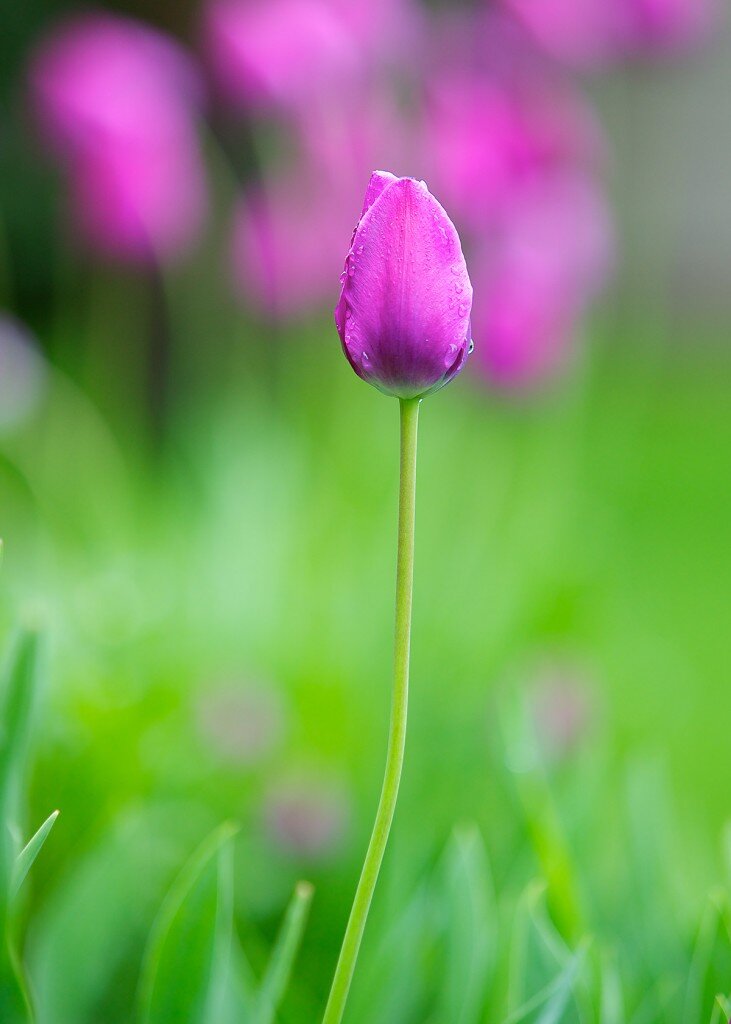
If you saw yesterday's post you might recognize this flower. Is it really the exact same tulip that Katie is holding? Only the tulip knows.But, like dandelions, this tulip is a genetic clone. It is an exact duplicate of all the other lavender tulips that came in the package of bulbs my wife planted. That's what you get when you have self-pollination and asexual reproduction. Humans, on the other hand, are a rich and varied species. Human duplication (I'm trying not to use the word "sex" here) is a little less convenient but the results are worth it.Which is to say that I'm glad I'm not a tulip. . .
Nature
A Bit of Color
I generally don't like selective coloring, which is what this photo illustrates. It's done in Photoshop. Compositionally, this is very simple photo but the software processing wasn't - I ultimately had 6 different layers in this photo. A goal was to emphasis the flower, which would have been the focal point even if I had done nothing to the photo.But I also wanted to soften the skin texture in Katie's hands, blur parts of the photo but keep the detail in the bodice of the dress.
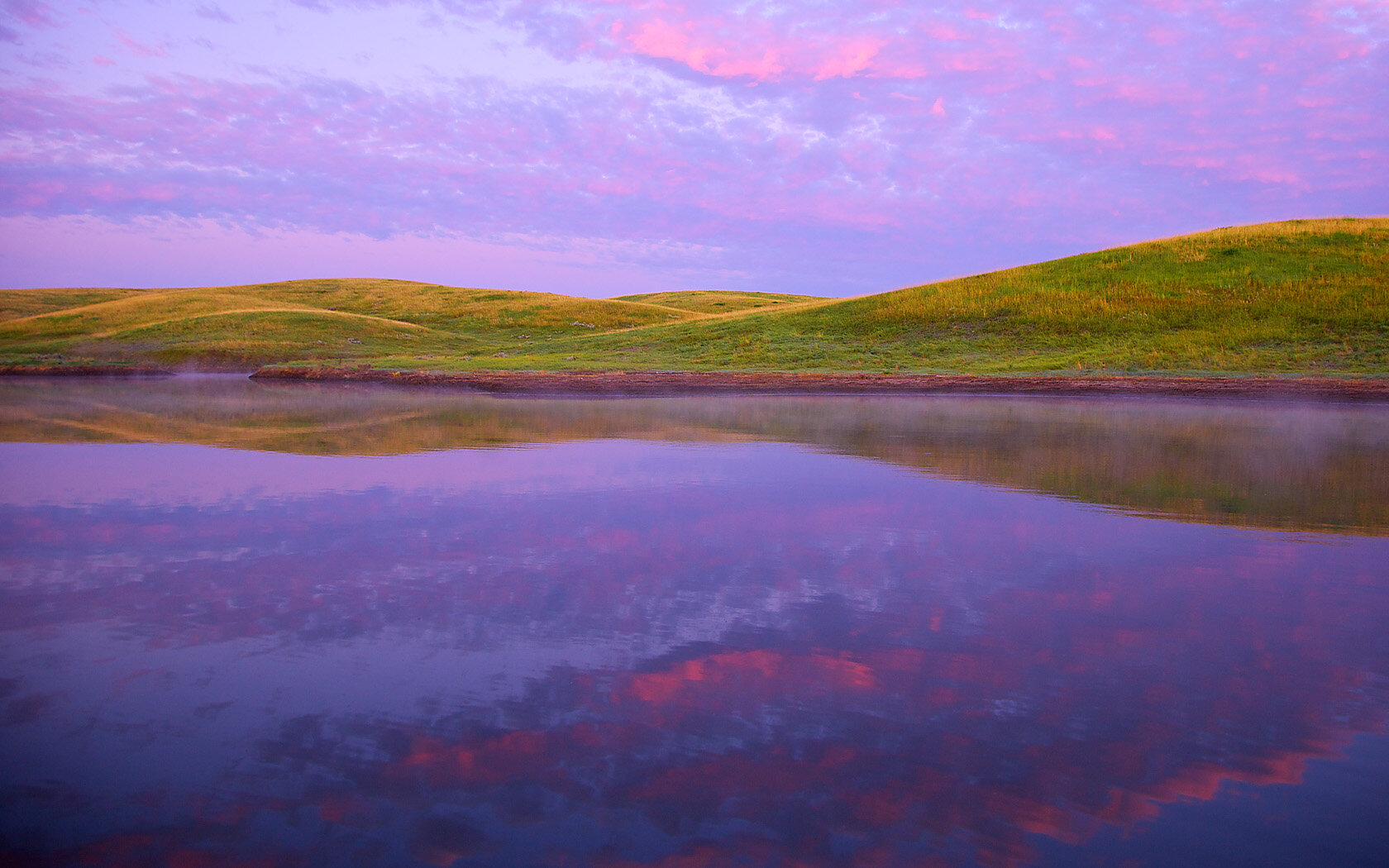
Mirror With Shades of Pink
As if to prove my point about redundancy (or obsession, compulsion, practice, repetition, etc.) here's a morning cloud shot.To be honest, though, when the sun rose high enough the morning I woke up in this back bay on Lake Oahe, this is the first thing that caught my eye: narrow, nearly pink clouds reflected almost perfectly in the calm, dark water of the bay. I also liked the silhouette of the land, which is almost black and nondescript.But enough words. . . Just imagine the cool, quiet calm that I was wrapped in when I took this photo.Or this oneAnd this oneAnd finally, this one
I Am No Claude Monet
Nor was meant to be. (As TS Elliot might say.)*But just as Monet painted canvas after canvas of haystacks in different light, I seem to photograph clouds at sunrise fairly regularly. Redundant? Just as it was with Monet, for me it's not so much about the subject; it's about the light. And the place. . . .*No! I am not Prince Hamlet, nor was meant to be;Am an attendant lord, one that will doTo swell a progress, start a scene or twoAdvise the prince; no doubt, an easy tool,Deferential, glad to be of use,Politic, cautious, and meticulous;Full of high sentence, but a bit obtuse;At times, indeed, almost ridiculous—Almost, at times, the Fool.Love Song of J. Alfred Prufrock
Still Seeing Green
I took this photo this summer but when and where I don't remember. For me, this is unusual since taking a photo is rarely a casual or unconscious decision. I am generally pretty "focused" and very aware of the subject, the place and the act.This photo isn't anything to write home about, though there is something simple and elemental in drops of water on deep green leaves. And I do like taking photos of vegetation.
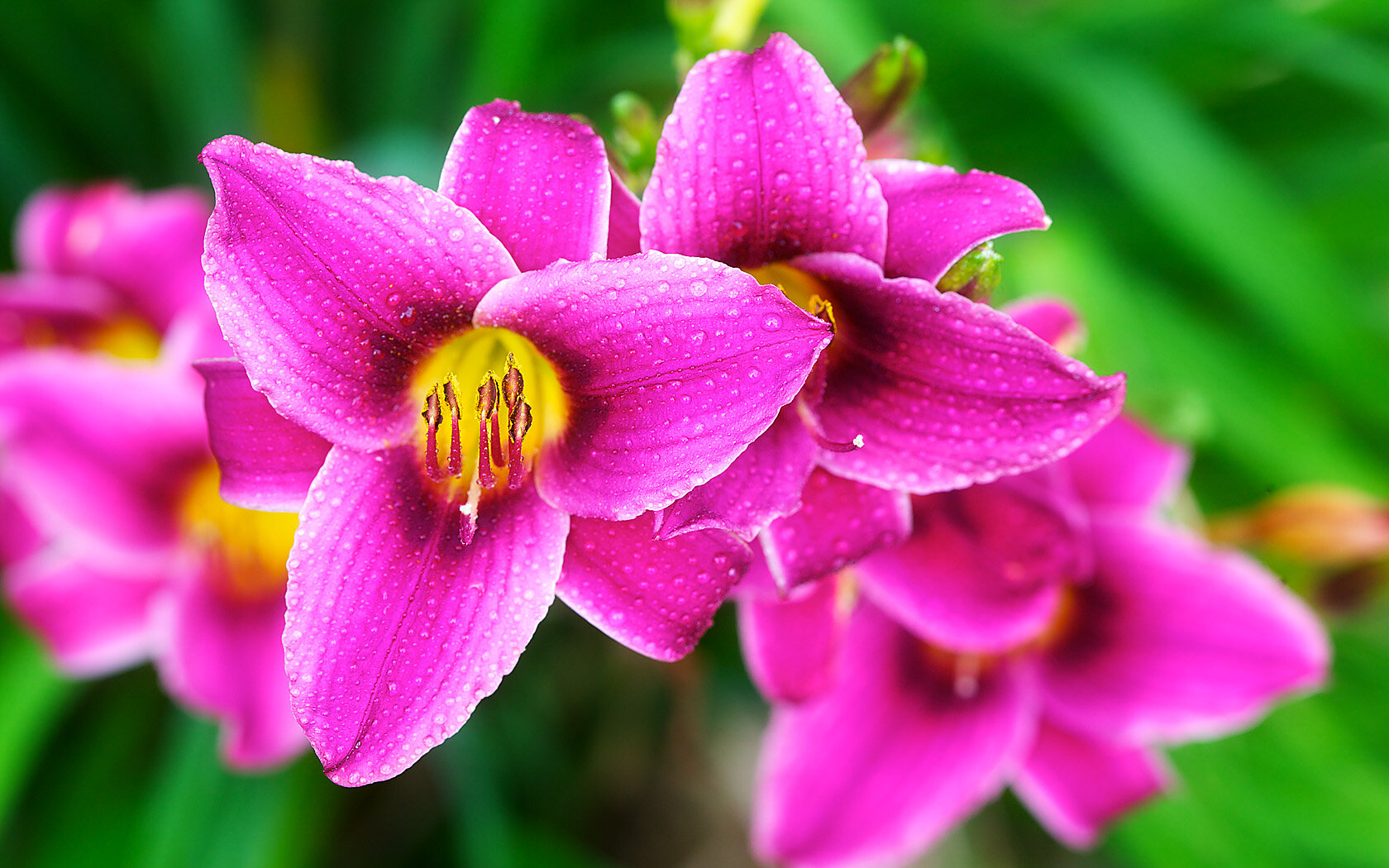
Hot Pink
Purple Dawn
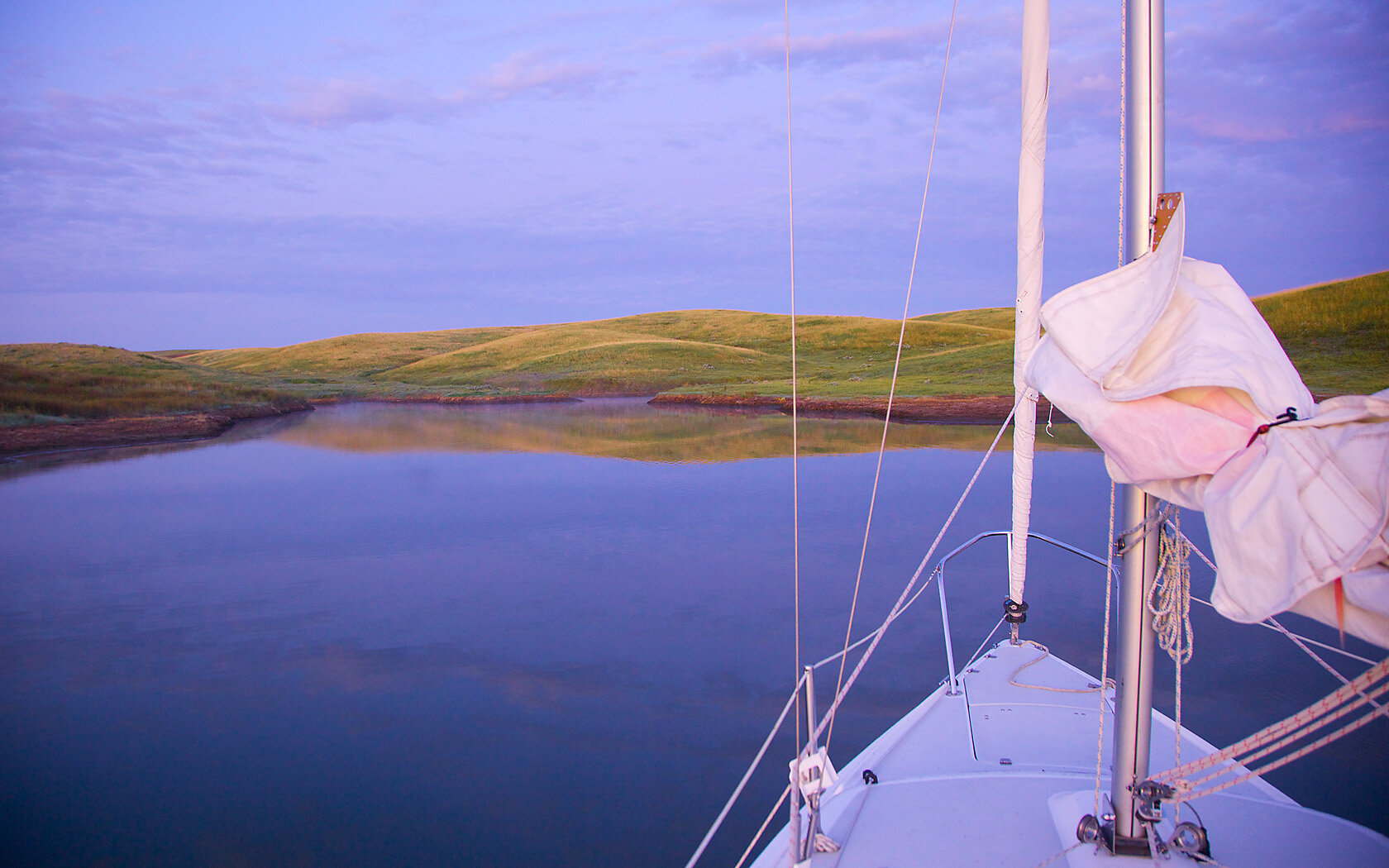
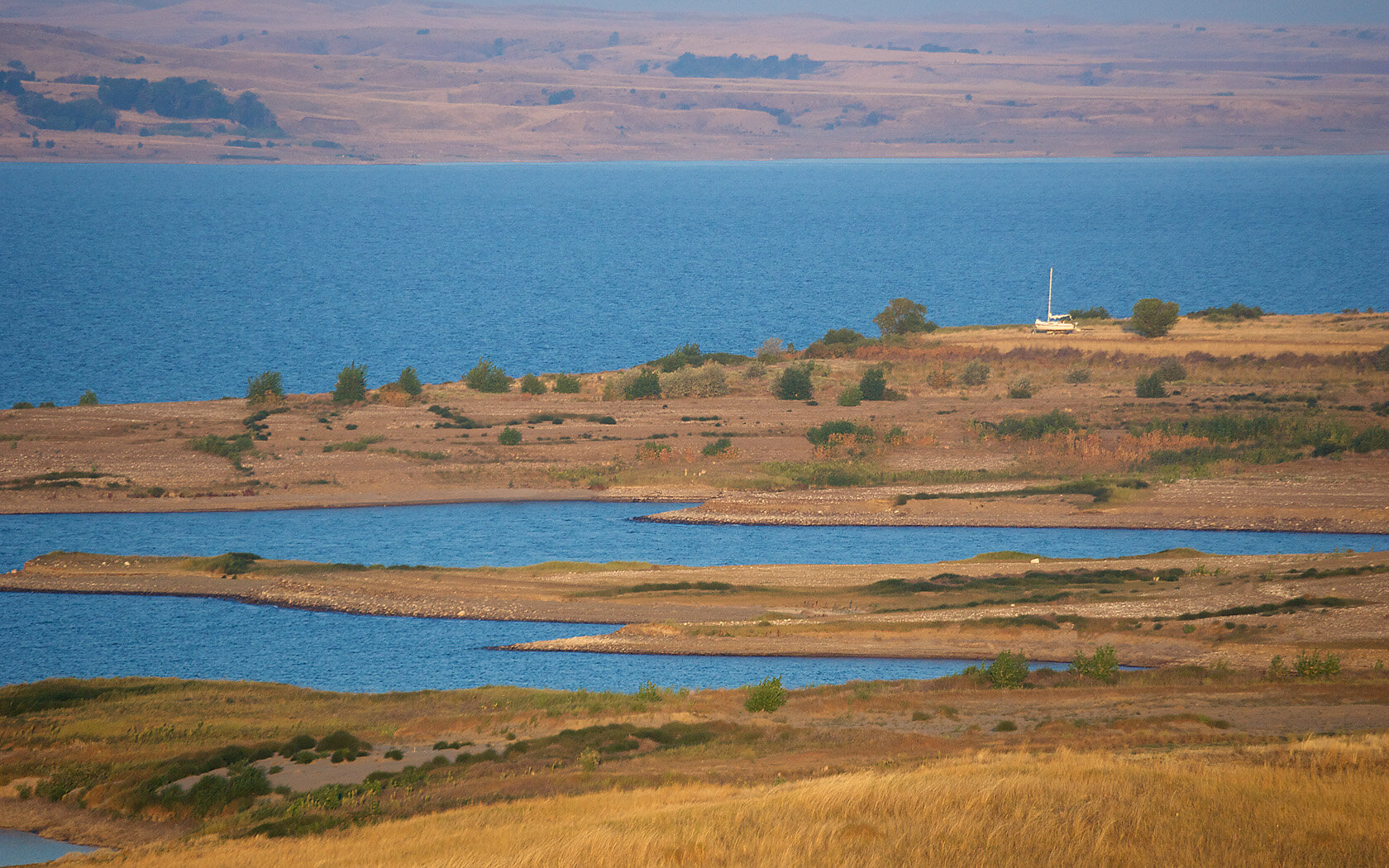
This is pretty much the same view as yesterday's post, though taken several minutes later with no sailboat to block the view.Seasoned Oahe boaters all know that one of the most unusual features of the shoreline this summer is that for late August, things are still incredibly green. Pierre, SD, which lies just south of the reservoir, has had 8" more rain than it normally gets by this time in August.For the sake of comparison, check out this shot of the Little Bend camp ground taken in early September in 2005 when the reservoir water level was much lower and central South Dakota was experiencing a more typical dry summer. As I study the 2005 photo, today's post makes it look almost tropical on the western shore of Lake Oahe.For those who like analogies, check out another sunrise photo taken of the Missouri in mid-winter. The hues are similar, though the water temperature is a few degrees cooler. :-)
First Light In Mission Creek
I made the 15 mile trip from the Spring Creek Marina to Mission Creek largely under power since the wind was light to non-existant. The weather forecast was for good weather overnight and light winds in the morning. For me there isn't much better in my sailing world than to wake up in a remote bay with calm winds and the hint of a glorious sunrise. And this morning was one of those experiences.When I first slid the hatch cover open and put my head out, I wasn't thinking of taking photos. But right away I noticed very light fog low on the water, which I thought was interesting. I also liked the curves of the sloping green hills that came down to the water's edge.Compositionally and aesthetically, then, I liked what I saw. But the problem was that there was very little light. But knowing that the camera sees things in ways that the eye can't, I thought that I'd crank up the ISO and see what I got. And you are looking at it.
Another View
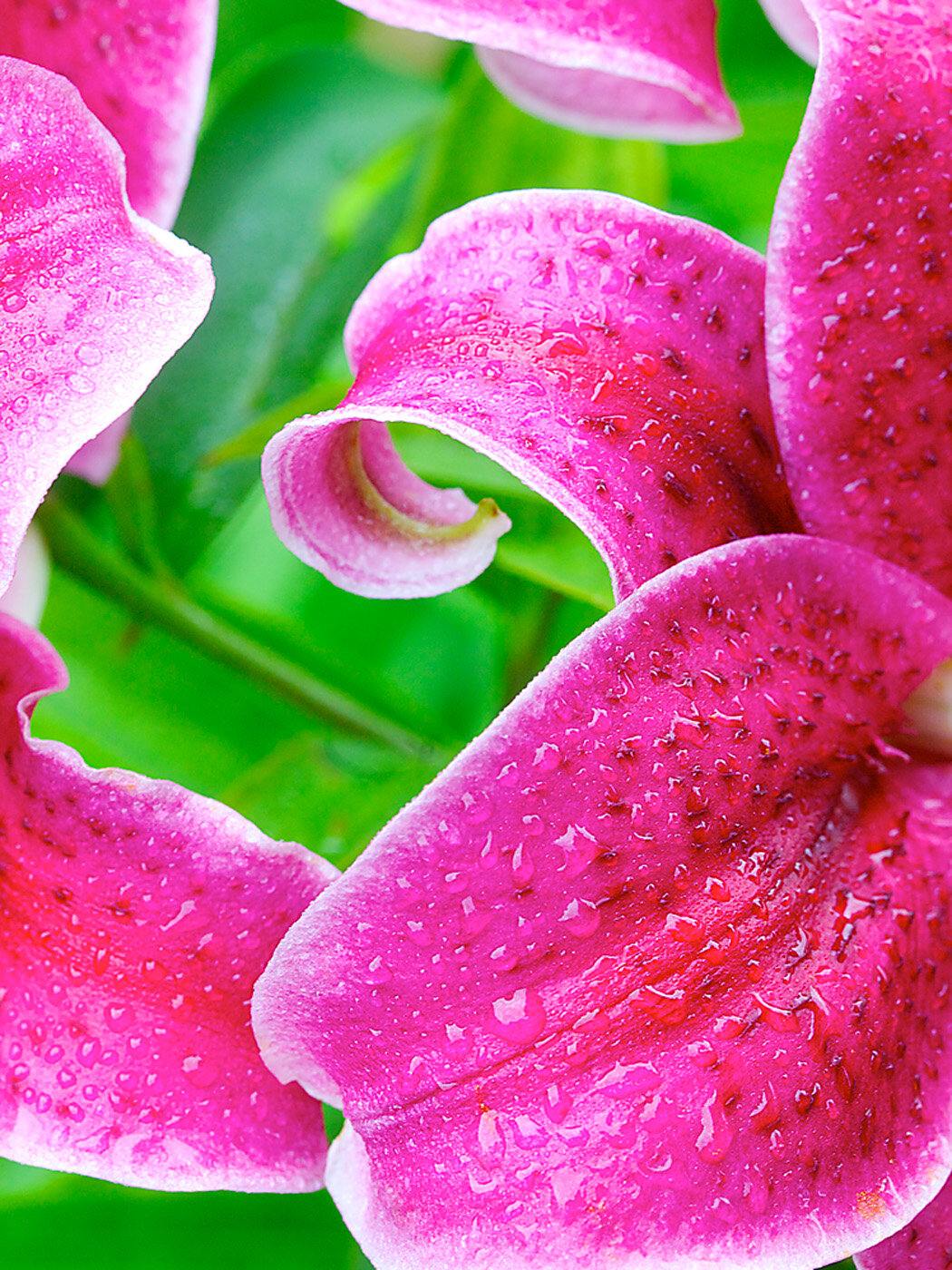
I think this is the third year I have photographed this lilly and this morning when I took my tripod and camera out to the garden, my goal was to try to see this beautiful plant in a way I hadn't seen it before.I have said before that photographers have the power to define reality by framing the field of view in ways that the human eye and brain don't. Thus, we can show the "big picture" in a way that makes it interesting and we can move in close to show things that people wouldn't normally look at. This photo is an example of this, I think.When I took this photo, I stopped looking at the whole flower and instead looked at its parts, its lines and it colors. I also looked at how these parts related to the background. To me an important compositional element is the way the edges of the leaves define the green space in the middle.Is it a good photo? I'm not sure that I could ever answer that question about one of my pictures. All I know is that I feel I met my goal of giving people a new way to look at the stargazer lilly.
One Good Tern. . .
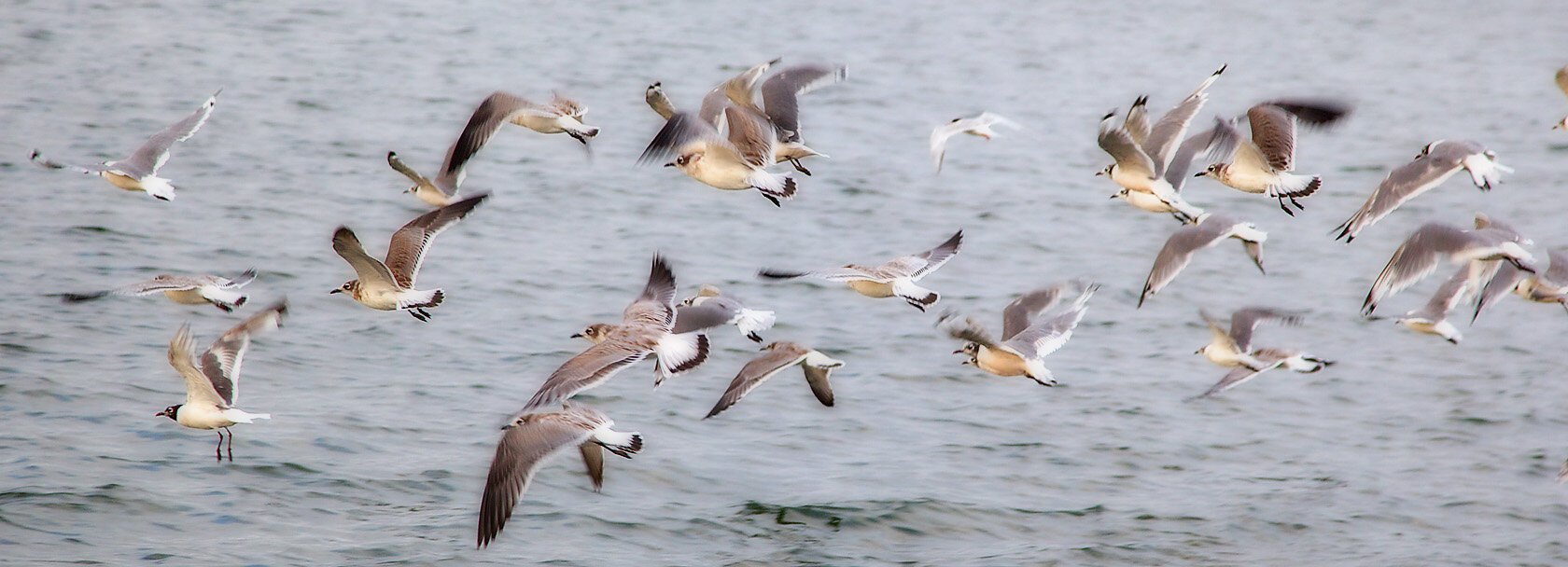
. . . deserves another, as the saying goes.The birds in this photo are least terns, whose nesting habitat, according to the Cornell Lab of Ornithology, "is found . . . on sandy beaches along the southern coasts of the United States and up the major river systems far into the interior of the continent."Certainly, Lake Oahe counts as "far into the interior", though they also nest along the Missouri River as far north and west as Montana. On Lake Oahe, they can be found standing along remote shorelines, floating peacefully on the water or resting on the rubber tire breakwaters at Spring Creek. Occasionally, their rest is interrupted by sailor/photographers who like to motor close to the tires just to watch the birds take flight.Lewis and Clark observed these birds and wrote about them in their journals. They even took two specimens for their collection. The birds were dead, of course, though I guess you could say the same about Lewis and Clark these days. . . .Living least terns go south in the winter, along with other South Dakota snowbirds. Where do they go? Mexico and South Padre Island are possibilities. But not Phoenix or Sun City.
Another Sunrise
The sun comes up every day, of course. In my life, there have been close to 21,000 sunrises and sunsets. On a small fraction of those 21,000 days I have been out with my camera. And on those rare days that I have my camera, it is rarer still to have the luck of good timing and photogenic skies.But this was one one of those mornings.
Not From Around Here
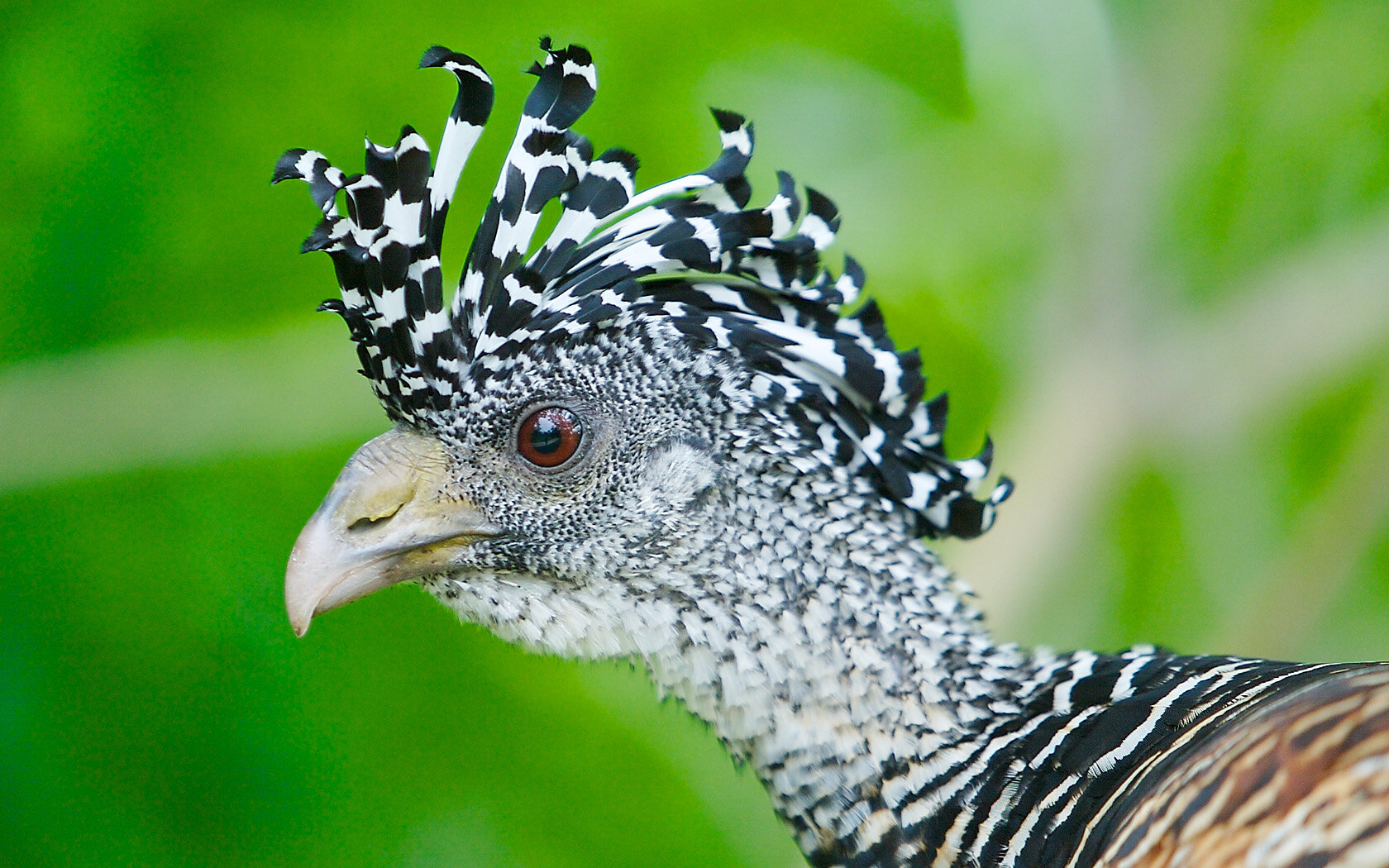
Here's a thought: this bird is related to the common sparrows that are plentiful in South Dakota. The evolutionary difference between this colorful bird and a sparrow is the environment their ancestors developed in. In the case of the sparrow, there is plenty of brown.In the case of this Mexican bird, though, the tropics have much more color, such as Hawaiian shirts and colorful bikinis. It's all about blending in . . .