
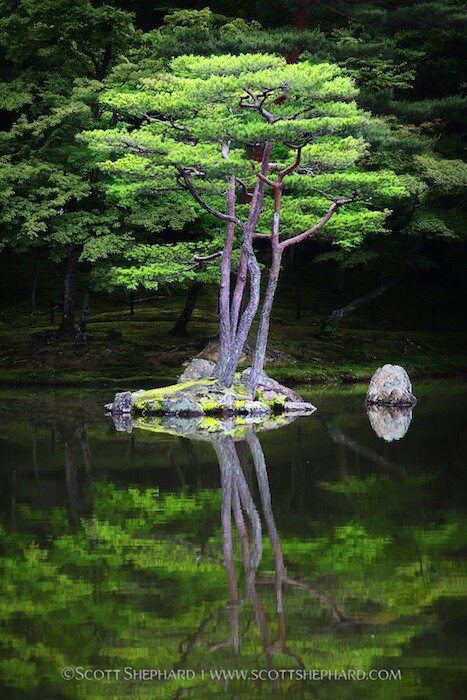
 I'll have to admit that I like this photo, which isn't something I'm inclined to say about my work. A photo should speak for itself, I guess.But I like this one because it's green, and South Dakota is anything but green right now. I also like it because I rescued it from the virtual dumpster. Finally, I like it because it helps me see the value of software processes in a photographer's work flow. I don't want to get technical in today's post but I will say that I started with this image (click), and ended up with the "adjusted" version in the blog. They say you can't fool Mother Nature. But she can be enhanced. :-)Kinkankuji is otherwise known as the Golden Pavilion, which is near/in Kyoto, Japan. Here's a satellite view (click) of the location. I wish I could tell you exactly where I was standing when I took this, but I wasn't in to GPS fixes in 2004, when we visited Japan
Landscape
12-05-12 HDR in B&W (Variations on a Theme)
in Blog, HDR, Landscape, South Dakota
 Yes, I repeat myself. But it isn't because I'm being lazy today. It's because I couldn't decided if I liked the color version of this photo (yesterday's post) or the black and white version. So I offer both.
12-04-12 Magical (HDR)
in Blog, HDR, Landscape, South Dakota
 This is another HDR photo taken on the same outing as "Back To Lonesome Lake." This one was taken 15 minutes before the Lonesome lake photo. At sunset, a minute or can be significant in the look you get. And, as I think you can see, 15 minutes can be worlds apart as far and the light and cloud cover are concerned.
12-02-12 Back To Lonesome Lake (HDR)
in Blog, HDR, Landscape, Nature, South Dakota
 It has been more than a year since I have photographed near Lonesome Lake. That session resulted in the photo I donated to the "fireplace room" at Lake Area Technical Institute in Watertown, South Dakota.On this occasion, I told Deb around 4:15 yesterday afternoon that I was going to go looking for a photo opportunity. I wanted to see if I could get something in HDR at sunset that would look good. Then, I invited her along for the ride and she said "yes." What a treat!I started heading north of our town, all the while watching the sun and clouds off to the southwest. My vision for the photo involved bare trees and a beautiful sky just before or just after sunset. I also didn't want any clear signs of civilization. If you go 20 miles north and a few miles west of Watertown, that isn't hard to do.After one other stop, I ended up at Lonesome Lake. By that time, the sun had set, and the clouds weren't all that interesting. But I thought that I could at least show Deb the location. It was getting dark but I decided to try to take a series of photos, knowing that the camera sees light in ways that I don't. I also knew that if I put my camera on a tripod and bracketed the exposures properly, I had several software tools that might produce something worth sharing.And here's the result. There is a surprising amount of texture in this photo, especially given that this (click here) is much closer to what I was seeing when I took the series. Pretty interesting, isn't it?
11-21-12 Primavera (Near Fort Randall)
in Blog, Landscape, South Dakota
 When I say "primavera," you might naturally think of pasta. Or, you might think of the famous painting by Boticelli. But primavera also means "spring" in many Romance languages, including Italian. And, because this photo shows the first blush of green on the bluffs above the Missouri River, I've given it a bit of a romantic title. It's not a photo of apetizing food and it doesn't feature women in diaphanous clothing. But does picture a serene and beautiful place in my home state.Incidentally, it occurs to me that as winter arrives in our state, I start to looking for photos that are dominated by green. What does that say about me?Did you know you can subscribe to my blog by going to the bottom right hand part of this page and simply typing your email address in? How convenient! Fifteen people are already doing this. How about being the 16th?
10-08-12 Bad Land? (HDR)
in Blog, Landscape, South Dakota
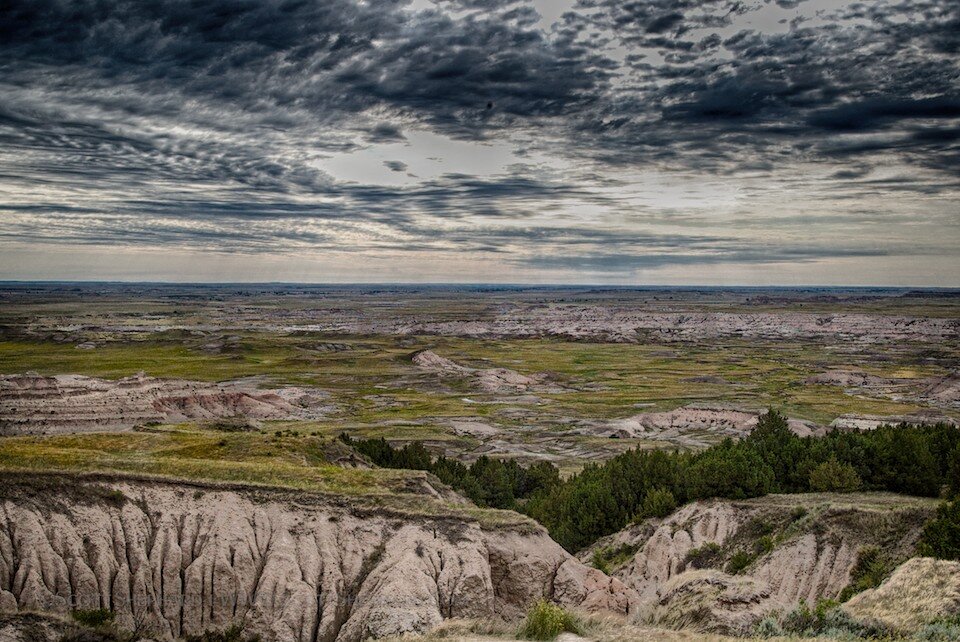 This one turned up after heavy duty "dumpster diving." I think I had abandoned it because I thought it was boring. Thus, I didn't practice what I preach in class: don't try to save bad photos with cool (but over the top) filters. I tried to save this one with an HDR filter. :-(
09-24-12 Winter Eclipse
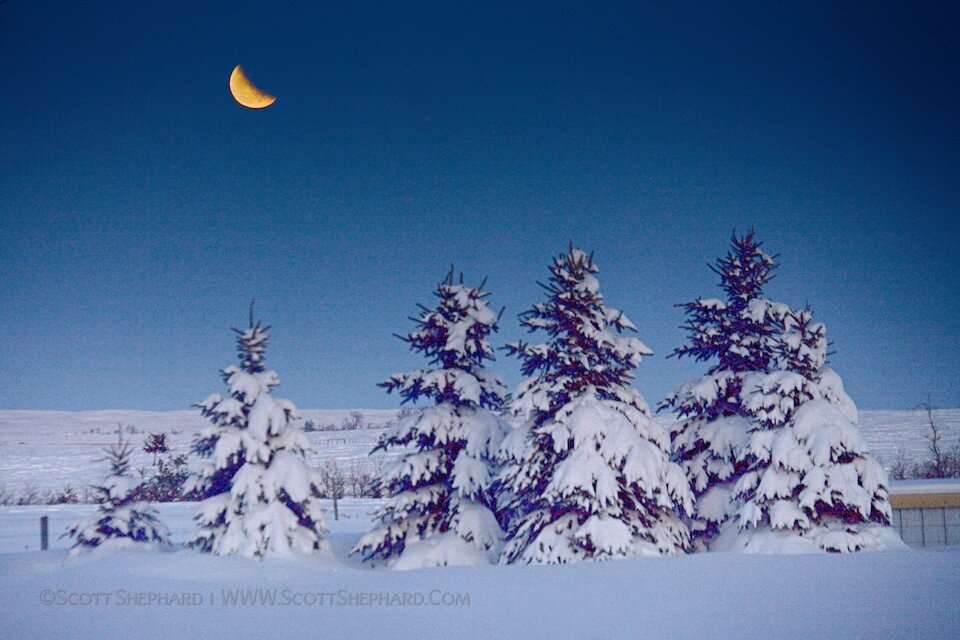 This is was shot in minimal light a few years ago. Having heard that there was going to be a total lunar eclipse on this night, Deb and I went driving to find a good locale to see and photograph the moon. I finally found this four trees posing nicely in front the waning moon.
09-18-12 Ready and Waiting
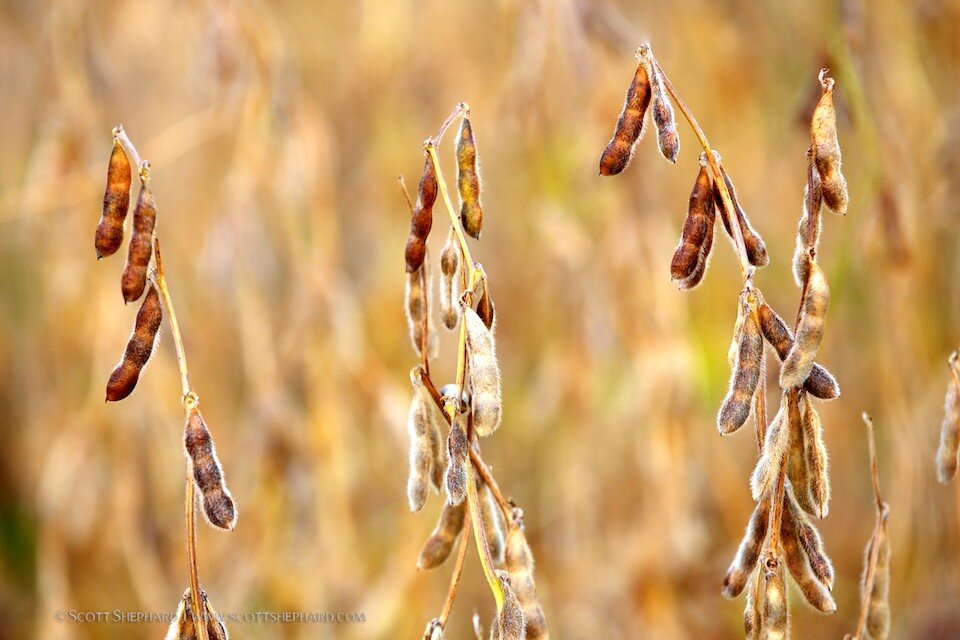 There is an adage in photography that says that you should first find a good photo opportunity and then turn and look behind you because the best photo is often something you don't see at first.This picture is a good example in that what caused me to stop my truck along the gravel road in Iowa was the photo I took yesterday. After getting what I wanted there, I turned and looked across the road. And this is what I saw (click). It wasn't all that special, was it? But inspired by one of my student's great soybean photos (check out Lindsey Fowler's photo), I decided to move in. And this photo is the result. And it stands as a good example of the tremendous power photographers have: we get people to look at things they would probably never taken the time to see.By the way, I like Lindsey's photo better. :-)Canon 5DIII 1/320s f/4.0 ISO320 182mm
09-17-12 Golden (HDR)
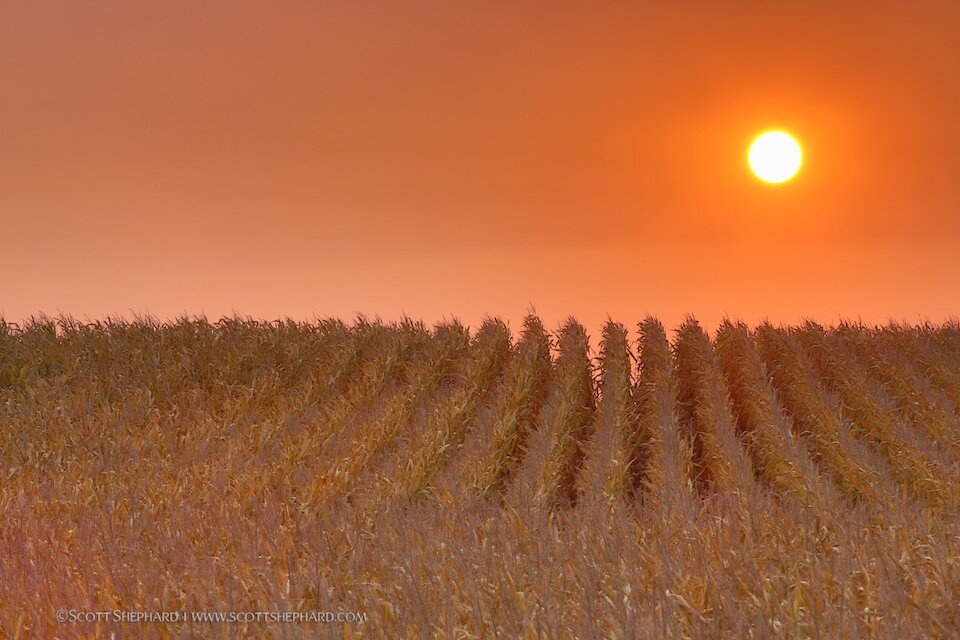 I was cruising the backroads of Iowa with my good friend BZ looking for one of my favorite subjects - an Iowa cornfield. The cornfield wasn't hard to find, of course. What is a little more challenging is finding other things that make the corn a little less run-of-the-millIn the case of this photo, the sunrise helped and so did the built-in HDR processor my Canon 5DIII has. I shouldn't point this out, but I think there is a compositional flaw in this photo in that I think it would be better if A) the sun lined up with the rows of corn or B) I had given a little more room to the right of the sun when I framed the shot. But, as they say, "It is what it is." And, to paraphrase the Rolling Stones, "It's only a corn field but I like it."Canon 5DIII 1/25s f/18.0 ISO320 200mm
80-30-12 Variations On A Theme
 Yes, another sunflower shot. They are looking east, incidentally, away from the setting sun. And, yes, they look east all day and all night long. When I was a kid someone told me that they actually turned so they always faced the sun. That would be a form of heliotropism, so my high school biology teacher would say.But sunflowers aren't that ambitious.Canon 5DIII 1/80s f/7.1 ISO100 200mm
08-14-12 Hand County, South Dakota
in Blog, HDR, Landscape, Photography, South Dakota
 This is another HDR (high dynamic range) photo that is actually a combination of two photos. I'm not sure I like the dramatic "rays" that seem to be streaming to the ground from the clouds because I didn't see them when I took the photo. And they look a little unreal.But they are real. The HDR process only enhances and demonstrates what the camera "sees." As I was looking at this photo, wondering whether I should post it, it occurred to me that light is to a good camera what the high pitched dog whistle is to a dog: the camera and the dog perceive things much differently than humans do. And though cameras are tuned by humans to show us what humans normally see in terms of color, brightness and contrast, software processes allow us to see an alternate reality. In this case it is an HDR photo that shows us what shadows under clouds look like.On a side note, I took this photo where I did to pay homage to my mother- and father-in-law. Years ago they had a painting hanging over their couch that was a winter scene showing a prairie that was table flat and that stretched out to infinity. My mother-in-law said the picture reminded her of home, which was Hand County, South Dakota.Though it isn't winter yet in this scene, the landscape is certainly table flat.
08-13-12 A Return To the Painted Trees
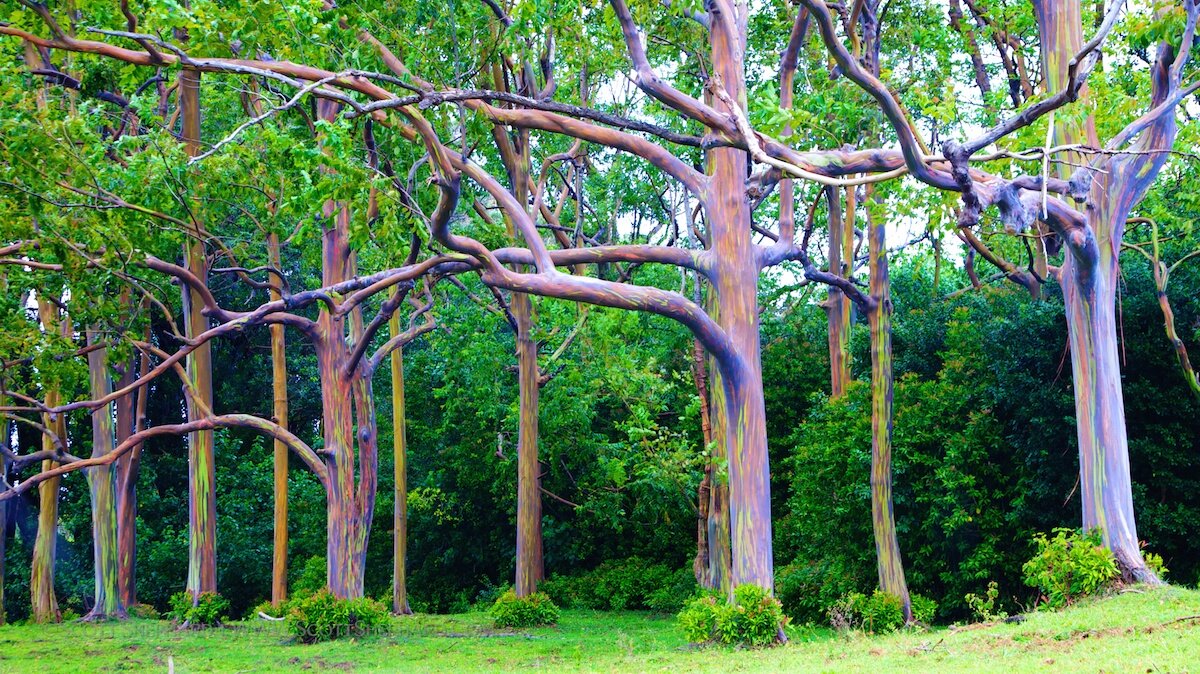 This is not the first post of these trees. But this photo offers a slightly different view and treatment. "Do they really look like that?" you ask. Well, I studied and taught philosophy just long enough to be confused by that question. So I'm not answering. . . .