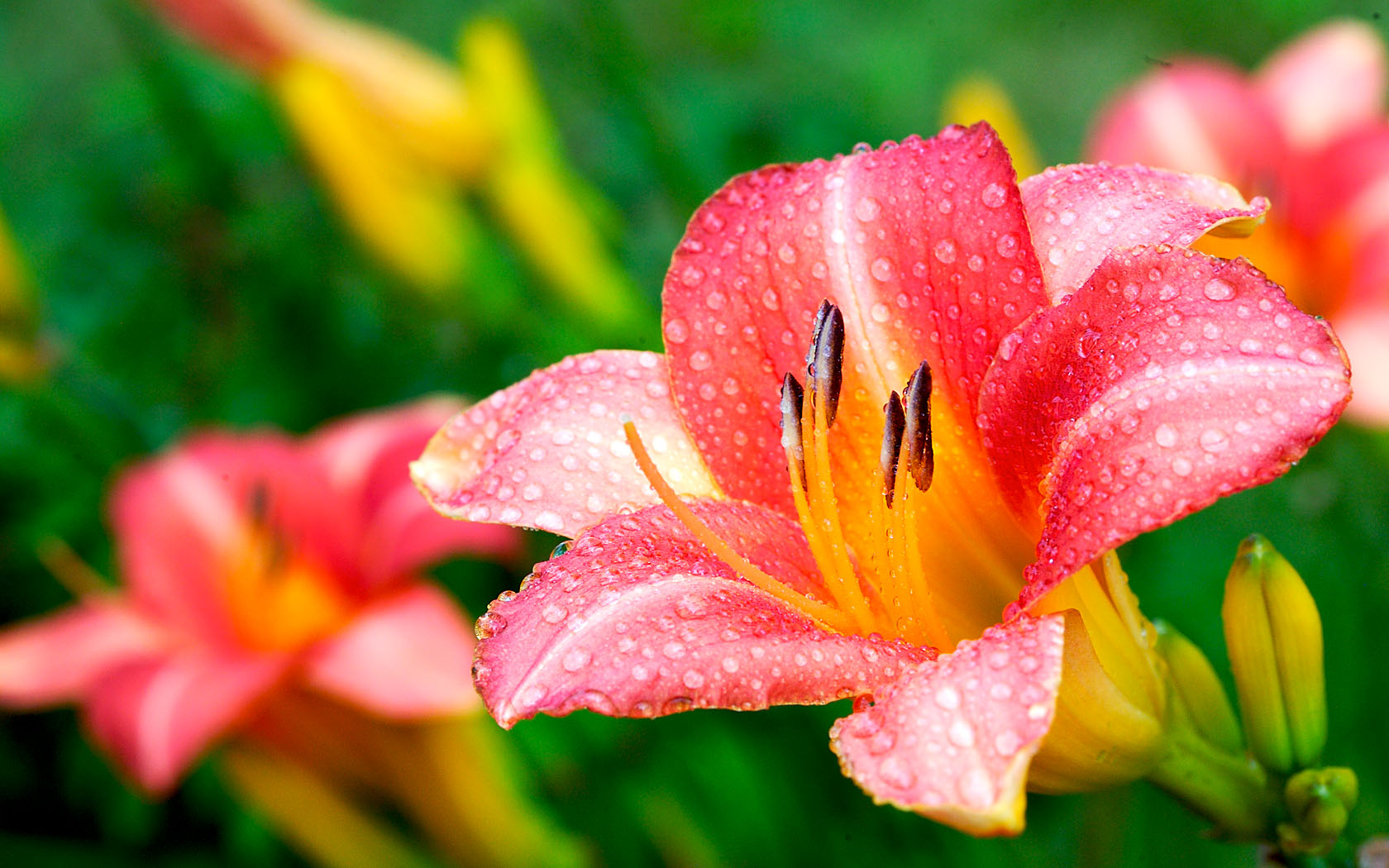
 Nature does a pretty good job of providing worthy subjects, doesn't it? Photoshop does the rest.
Canon 5D 1/60s f/11.0 ISO400 100mm

Nature
Nature does a pretty good job of providing worthy subjects, doesn't it? Photoshop does the rest.
Canon 5D 1/60s f/11.0 ISO400 100mm
 Here's another macro photo that renders the subject a little abstractly. Donna, my neighbor, urged me to check out her roses and this is what I saw. Thanks, Donna, for growing them!
Canon 5DII 1/80s f/6.3 ISO200 100mm
 Yesterday's Alaskan adventure was to motor to Kruzof island and ride Yama Rhinos (a heavy duty ATV) through the woods. This is one of many spots where hardwood trees have grown along the narrow, rough and pond-rich roads.
When we got back home around 8 pm, we were tired, dirty and more than a little sore. When our son, Jon, is leading us, quiet museums and art galleries aren't usually part of the itinerary. And that's OK with us!
 Here's another one from the Raptor Center we visited in Sitka, Alaska. I don't know the story on this beautiful bird aside from the fact that he/she is a survivor who now has a permanent home showing off to photographers and other visitors.
For the tech geeks, I should mention that this photo is about a 3/4 crop, meaning that I threw about 3/4 of the photo away. I was wondering why I needed a camera with 23 million pixels and this photo is the answer. Of course, it helps to shoot with a lens like the 70-200 2.8L.
 Dead flowers covered in frost on a cold November morning. Try thinking of that when you are about to bemoan the humidity or heat or thunderstorms that are part of summer in our beautiful state.
There is an otherworldliness to this subject, isn't there? Would you have know what this was if I had identified it?
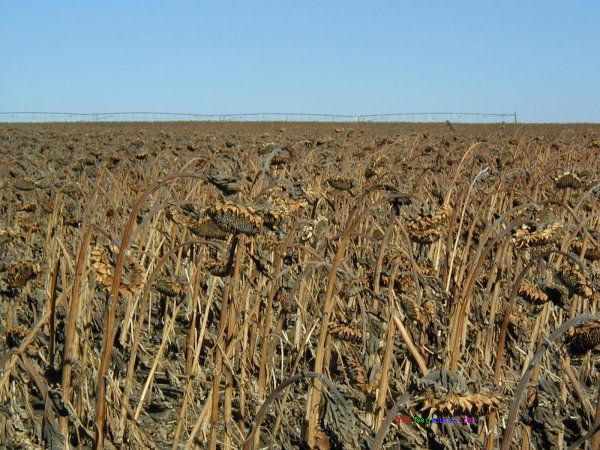
 Here's another photo of sun-ripened crops - this time a seemingly endless field of sunflowers. Sunflowers are a bit of a paradox in that I don't know if there is a crop in South Dakota that is more beautiful when it is in its prime or more ugly when it is ready to be harvested.
Here's a close-up of one of the flowers. (Click here)
1/320s f/6.3 ISO400 300mm Canon 1DII
 Our hens and chicks have decided to bloom this year and this is what the flower looks like. It measures 3/4" from tip to tip. Each of the round ball-like structures ringing the center of the flower will be a smaller bloom. Without a macro lens, all of this would be easy for the camera and the eye to miss.
But here's something interesting: I am struck by symmetry in nature and so I counted the two most obvious elements in this flower. And I discovered 11 petals and 22 little balls. I also discovered that if you count the red and black dots in the center of the flower, there are 11. And now I'm wondering where else the number "11" and its multiples occur in nature. . . .
Canon 5DII 1/50s f/8.0 ISO800 100mm
 The wheat is a not yet ready to harvest in our state but I noticed that it is getting close. This photo was taken a few years ago north of Watertown on a dewy morning just as the sun was coming up.
Canon 1DII 1/125s f/5.0 ISO400 70mm
 This is a tree that lives in the park in front of the Colorado state capitol building. I like the apparently random nature of the lines and angles in a tree. But in this photo, I also like the texture of the bark.
1/125s f/7.1 ISO400 60mm
 I was done taking pictures on this particular morning and was heading back to our cabin. As I drove down the road along a small lake, I noticed a single deer along a path that paralleled the road. I thought, "I may have my next 'Picture of the Day.'" My concern was that if I got out of the car and started taking photos, the deer would run off. Instead, he/she struck a pose.
1/60s f/5.6 ISO320 105mm
 There is nothing in this palm leaf that identifies with the Greek island of Corfu. But that's where I took the photo. I like the random stringy threads that seem to contrast with the regular fan of the palm fronds.
 I haven't had a chance to photograph the iris (or is it "irae" or "irises"?) that are blooming now so I resurrected a photo from a few years ago. There is very nice background blur on this one thanks to the 28-200 2.8 lens I used.
Canon 5D 1/80s f/6.3 ISO200 200mm