As I browsed looking for a photo to post, this bright, pink rose called out to me. And those are real rain drops.
2014 01-25 Dreaming of Spring by Watertown, South Dakota, photographer Scott Shephard

Nature
As I browsed looking for a photo to post, this bright, pink rose called out to me. And those are real rain drops.
I had a version of this photo ready to go several weeks ago but I had already posted several "fall color" shots so I put the maple seed pods picture on the back burner. Last night, in a quest for a photo with rich colors to use for a class demo, I came across the maple tree photo and started to play.
And all of a sudden, my "fall color" photo was converted to black and white. Why is that? Well, in part, I am partial to black and white treatment of subjects because the emphasis switches away from color to lines, shapes and textures. But I also am posting the black and white version because just after I converted the original to this, my wife walked in the room and said, "That's nice." And I trust her critical judgement.
If I had a true scientific interest in coral, I would have answers to the many things I wonder about when I look at it. I wonder, for example, about the many ways that coral seems to organize itself. I wonder about the age of coral we find along the shore. And in the case of this piece, I wonder what the pink substance is.
But I don't have a scientific interest in coral and I don't seek answers. In the case of coral I take comfort in my wonder.
Canon 5DIII 1/640s f/5.0 ISO200 100mm
I encountered this tree branch on a short hike on a rainy day while Deb and I were sailing in the Virgin Islands. I'm not sure if the caterpillars were seeking shelter from the rain on the underside of the branch or if they were up to something else. Though what caterpillars might be "up to" is a bit beyond me, not that I would attempt to pass judgement on the purpose of a caterpillar's life. . .
I have written about the "countless unseen details" that artists concentrate in their attempt to approach the "sublime" in their creations. In the case of this composite photo of brain coral, my title refers to Nature as the creator, not me. Frankly, all I did was record and compile the detail in this coral. But, as macro photography often does, you are being allowed to look at coral in a way you may not have done before. And there is amazing detail here that often goes unseen.
Brain coral evokes a powerful childhood memory in me, incidentally. My grandma, who lived next door to us in Sioux Fall, SD, had a perfect piece of brain coral on her front porch. I was fascinated by it largely because my older brother told me it was a petrified human brain. That was so cool. But why did Ida have a petrified human brain on her front porch, I wondered? Oh, to be a child again. . . .
I had mentioned yesterday that I had another photo that showed a drastic difference between what the human eye sees and what the camera "sees." Yesterday, the difference had to do with focus, depth of field and bokeh. What today's photo demonstrates may not be so obvious unless you understand the concept of "dynamic range."
Dynamic range is the term used by digital photographers to describe a camera's ability to show the range of shades in a scene from very bright to very dark. And, generally speaking, cameras don't do such as good job compared to the human eye, which is brilliant.
When I saw this palm leaf, singled out by the relatively bright sky above, I didn't see what you see in the photo. I saw the highlights as bright green and the shadows as dull green. And when I took the photo and looked at it on the built-in screen, I thought, "Wow! I didn't see that." And I liked it.
I'll admit that I did use a few fancy software processes to boost the dynamic range of the photo a bit. But I didn't want to kill the highlights you see here. Is is a good photo? I can't say. But, as I've already said, I like it.
Canon 5DIII 1/60s f/4.0 ISO640 102mm
And for detail junkies, Here's the raw, unprocessed file
My title for this post isn't so much about the fact that we don't see rain, or rain-drenched leaves in our normal experiences. Though most people rarely stop to study a leaf as closely as I'm asking you to do it here.
What I mean is that the camera "sees" things very differently than humans do, including color, contrast and focus. And for sure the human eye can't see unfocused areas* as the lens does because when we look at another point in a scene, our eyes automatically focus there.
And discovering the unexpected is one of the reasons I find so much joy in making a photo.
And speaking of joy, welcome to 2014! I will be celebrating five years of "A Photo A Day" soon and I do appreciate you, the viewers, who certainly provide another source of joy for me.
*The unfocused areas are called bokeh. In this photo, the blurred circles in the background are other rain drops hanging on other leaves like the one you see in focus here.
Canon 5DIII 1/100s f/4.0 ISO400 102mm
 When you look closely at the amazing details of a frosty window it's not hard to understand why someone chose to personify the creator under the name of Jack Frost. Ever since I was a child, I've been fascinated by the seemingly random yet ordered patterns of the kind seen in this photo.
Unfortunately, due to improved window glazing, this kind of window frost is less often seen. But fortunately my son and his family live in a venerable older home in St. Paul, MN. They may not appreciate the heating bills but I appreciate the beauty of Jack Frost's art.
If you would like to see more of this series (8 more photos) click here.
Canon 5DIII 1/60s f/5.6 ISO100 100mm
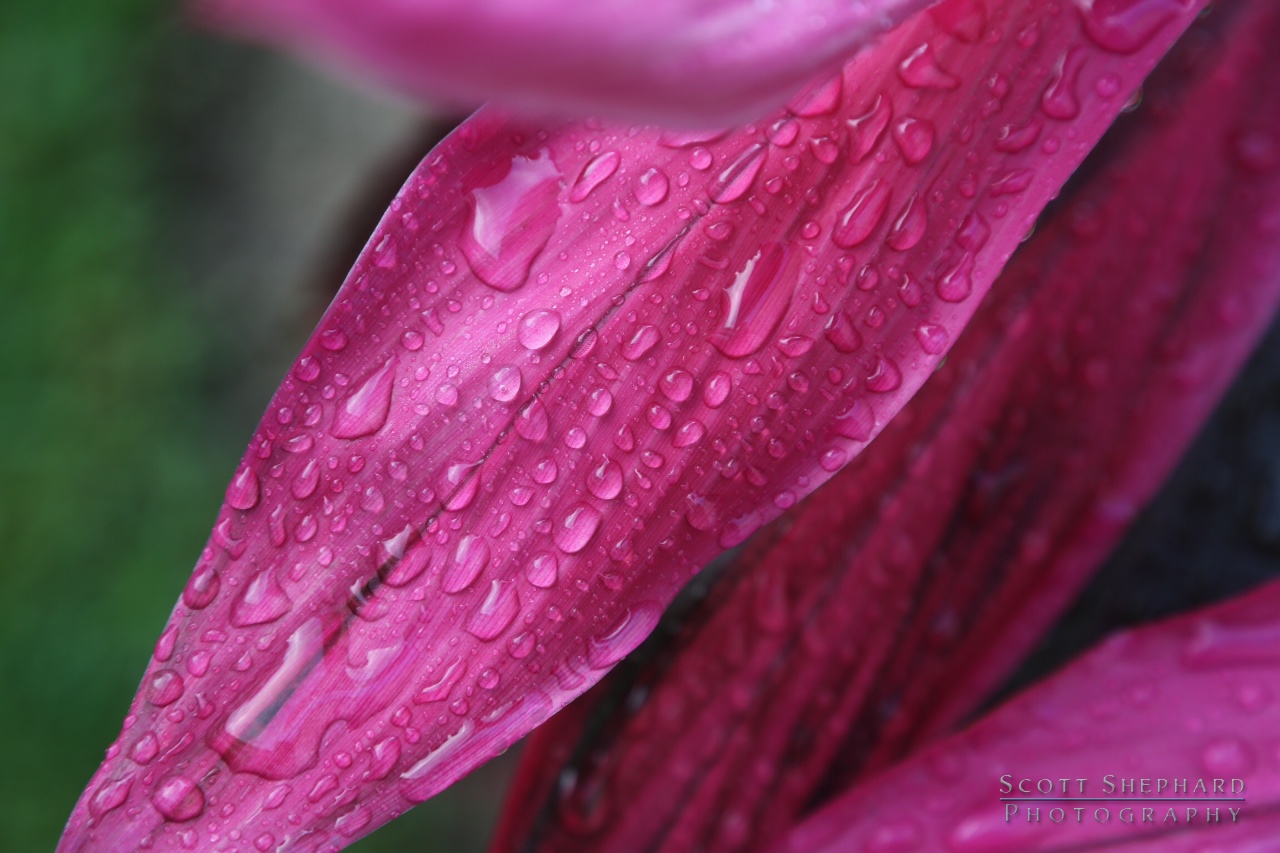 We arrived back in Minneapolis last night from a week in Mexico. The temperature was a balmy 27 degrees F. But in Watertown, SD, it is -14.
And so I thought it was appropriate (and maybe even good for the soul) that I should post a photo of a tropical plant covered with rain drops that I saw yesterday morning at the resort we were staying at. But in spite of the 94 degree temperature difference, I am happy to be on the way home.
I taking a bit of a break from writing and in the process giving you at bit of a break, as well. Enjoy the photo.
Canon 5DIII 1/30s f/4.0 ISO400 100mm
This is the third in a series that I am now calling "Shades of Green in Black and White." This one was taken in the fern room at the Como Park Conservatory. I won't tell you what I like about this photo other than that I love the play of light on the contours of the fern fronds.
Canon 5DIII 1/50s f/6.3 ISO500 100mm
On my recent trip to Minneapolis and Saint Paul with students in the Photo/Media program at LATI, we spent about an hour in the Como Park Conservatory. I had been there several times before so I wasn't sure that I would find anything new to photograph. But while there I did take 97 photos, some of which were HDR sequences.
Of those 97 photos, 37 were taken of the palm trees in the central dome of the conservatory. So I guess you might say that that the trees captured my attention. And this shot is one of several that I took of the very top of the central palm tree.
In black and white it may be a bit abstract in that you don't see the context of the tree. But that's alright with me. As I've said before, I like the ability to take a "whole" and show the parts in a way that the viewer might not be able to see without the aid of my camera.
Canon 5DIII 1/60s f/5.0 ISO250 100mm
For context, here's another capture (HDR) that shows more of the tree and of it's location:

