I taking a bit of a break from writing and in the process giving you at bit of a break, as well. Enjoy the photo.
Canon 5DIII 1/30s f/4.0 ISO400 100mm

I taking a bit of a break from writing and in the process giving you at bit of a break, as well. Enjoy the photo.
Canon 5DIII 1/30s f/4.0 ISO400 100mm
This is the third in a series that I am now calling "Shades of Green in Black and White." This one was taken in the fern room at the Como Park Conservatory. I won't tell you what I like about this photo other than that I love the play of light on the contours of the fern fronds.
Canon 5DIII 1/50s f/6.3 ISO500 100mm
On my recent trip to Minneapolis and Saint Paul with students in the Photo/Media program at LATI, we spent about an hour in the Como Park Conservatory. I had been there several times before so I wasn't sure that I would find anything new to photograph. But while there I did take 97 photos, some of which were HDR sequences.
Of those 97 photos, 37 were taken of the palm trees in the central dome of the conservatory. So I guess you might say that that the trees captured my attention. And this shot is one of several that I took of the very top of the central palm tree.
In black and white it may be a bit abstract in that you don't see the context of the tree. But that's alright with me. As I've said before, I like the ability to take a "whole" and show the parts in a way that the viewer might not be able to see without the aid of my camera.
Canon 5DIII 1/60s f/5.0 ISO250 100mm
For context, here's another capture (HDR) that shows more of the tree and of it's location:
Yesterday I went to Minneapolis and Saint Paul with a few of the second year LATI photo/media students. This photo was taken on our last stop at the Como Park Conservatory, which is a great place to visit on a cold December day in part because it is warm and humid inside and in part because the color green abounds. And, as I've mentioned, in winter here in South Dakota, I seem to be drawn to green things.
So I like green and yet I've stripped the color out of this fern. Why? As a photographer I sometimes like lines, texture and tonality and sometime color distracts us from those things. Over the next few days I will posting a few of my favorites from the Conservatory and from the Minneaplis Institute of Art, where we also stopped for a while. If you want a sneak peak, I've posted a few more photos here. (click)
Canon 5DIII 1/50s f/6.3 ISO500 100mm
This is a place I've photographed four or five times, but always in different light. Yesterday morning I had only a few minutes to get this scene before the beautiful pink hues were washed out by the rising sun. One of the features of this scene that I like is that the snow cover is light enough that the brown grass underneath allows for contrast and texture.
I will admit that I was a little lazy in that I shot this through the open passenger window of my vehicle. I am a bit of a perfectionist and yet I use imperfect practices from time to time. Why is that? Well, yesterday morning it was -3 fahrenheit. But that's a poor excuse. . . .
Here are two previous posts. The framing is a bit different in today's post and, interestingly, where there used to be two trees in the foreground there is now only one.
 Someone once suggested that "Countless unseen details are often the difference between the mediocre and the magnificent." When I teach photography, this is one of my many mantras: what helps our work rise above all of the billions of photos being taken is our close attention to details and our true understanding of what those details are.
This photo is not presented as an example of the "magnificence" but this detail of the Cathedral of the Madeleine in Salt Lake City is. If you look at a broader view (click), you will will find that while the figure of Jesus is the centerpiece of the this facade of the cathedral, it is only one small part.
And I can assure you that the architects and sculptors did not intend for this statue to be seen with a telephoto lens attached to a high resolution camera as you are seeing it.
So why are the edges of the pages of the book so carefully rendered? And why is there so much detail in the face and hands of Christ that would not be seen from a distance?
The answer is simple: these were all done in a quest to create something that was truly magnificent.
 When Deb and I paid the entrance fee for the Lauritzen Gardens in Omaha, Nebraska, a few weeks ago, we weren't expecting much given that the gardens were past bloom and prepared for winter. But we were surprised by what we found. And even if we hadn't found anything worth seeing, it would have been good just to stroll through a largely deserted landscape on a nice November day.
I suspect that many gardeners would feel that what you are seeing here is a mess that needs to be cleaned up. But I see a great mix of lines, colors and textures. This isn't quite like Monet's famous lily ponds at Giverney but this but perhaps a way to pay tribute the one of my favorite artists.
Canon 5DIII 1/250s f/5.0 ISO200 100mm
 It occurs to me that in the Black Hills of South Dakota, where this photo was taken, the ponderosa pine is visual white noise in that there are so many of them and, unless they are fallen or bug infested or on fire, they are rarely seen.
Good photography often involves being in the right place at the right time. But good photography also is about directing the camera towards things in ways that help people "see" scenes, events and objects in ways that make them worth noticing.
So today I present a detail of a lowly ponderosa pine which has probably been standing largely unnoticed for 50 years. And what is special about this tree branch? Perhaps nothing. But when photographed at the the right time with the right light, it is certainly interesting and, I think, worth stopping and looking at.
Canon 5DIII 1/200s f/2.8 ISO200 200mm
 My friend Dennis Newman, who is an artist and an art/photography instructor, says that good art (including photographs) should invoke emotion. I heard him say that about a year ago and since then I have tested most of the photos I post here with this question: "What do I want my viewers to feel and think?" Not all of the photos I post have a certain answer to this question, though I've been posting long enough to know that what I feel as the photographer isn't always the same as what you feel as the viewer. Such is the nature of art. . .
A problem that photographers often have is that a photo that they have taken invokes strong emotion in them but is otherwise meaningless to their audience. And perhaps today's photo is an example. Many might say, "An orange float in a big, nondescript body of water? Big deal!"
But if you live where it is very cold (-9 fahrenheit in South Dakota today), and if you live where the world appears predominantly in tones of white and gray (South Dakota in December) and if you love warm sun and water (I do) and if you love the solitude and silence on a reservoir on the high plains (me, again) and if you like the color blue (guess who?) then you can't help but feel something when you see this photo.
And if I am the only one, oh well. Not everything I photograph turns out to be art. . . .
GoPro Hero III Black Edition 1/589s f/2.8 ISO100 2.77mm (35mm eq:15mm)
 Deb and I took a hike through a nature area on our visit to St. John in the US Virgin Islands this past June. I spent quite a bit of time photographing the plants that grew on plants here, much like this air plant is growing on the side of a small tree, which is also host to a vine that is curling upward. Are these plants friendly and helpful to each other? And is that what symbiosis means? Or are we seeing evidence of parasitism?
And are these questions really necessary if, like me, all that is striking about this place are the rich green hues and filtered light in a shaded forest?
Canon 5DIII 1/60s f/4.5 ISO640 60mm
For those who might be interested in seeing a more mundane but much more "unnatural" place for one of these to grow, check out this photo, which I took on a walk in Charlotte Amalie in the BVI:

 I posted a great face yesterday so I decided to post two great faces today, this time of our grand daughter Glenyce Jane and one of G's namesakes, my mother-in-law Glenyce D. I'm lucky to have them both in my world and I'm learning to interpret Glenyce J's facial expressions. This one says, "You're pretty cool and I like you."
I get the same look from my mother-in-law all of the time. :-)
Canon 5DIII 1/125s f/5.0 ISO800 90mm
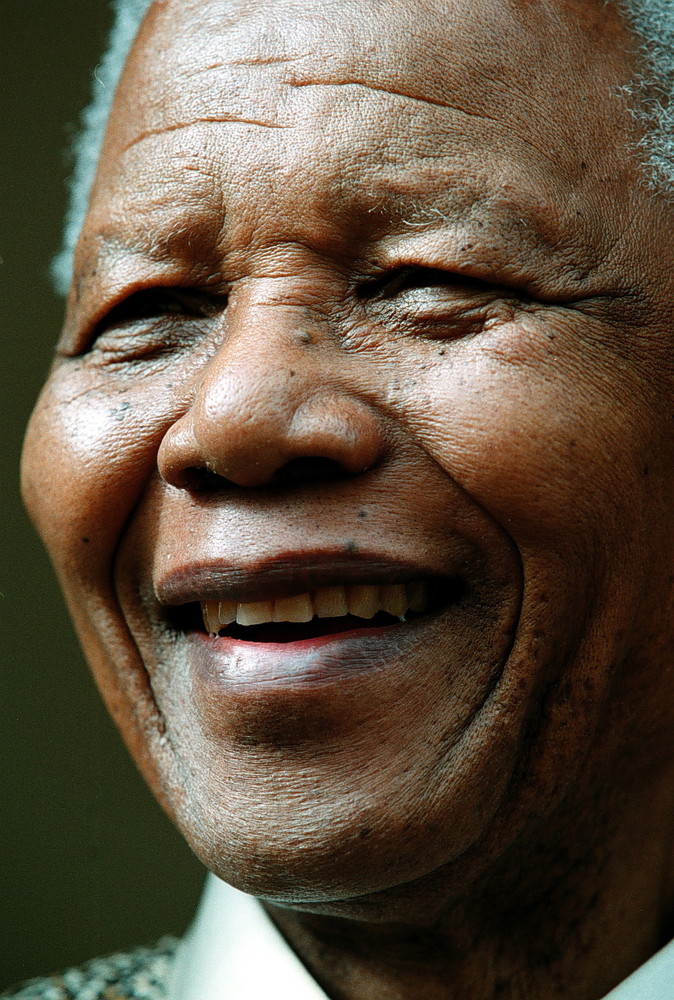 Given all of the talk in the wake of the death of Nelson Mandela, I felt compelled today to offer a small tribute him and his legacy. He not only helped change the face of South Africa, he also helped change the way many think about race and equality. The photo is not mine and I hope that's OK.
Four quotes of his strike me as particularly meaningful today
"I am not a saint, unless you think of a saint as a sinner who keeps on trying."
"Do not judge me by my successes, judge me by how many times I fell down and got back up again."
"Resentment is like drinking poison and then hoping it will kill your enemies."
and
"It always seems impossible until it's done."


